
 1/2
1/2

USA 2026
Opening June 18, 2026
Directed by: Michael Sarnoski
Writing credits: Michael Sarnoski
Principal actors: Hugh Jackman, Jade Croot, Bill Skarsgård, Jodie Comer, Katie Breen, Tabitha Smyth
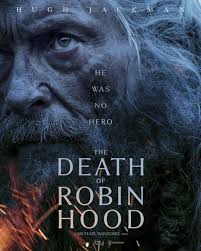 Unlike the swashbuckling tights-clad Robin Hood and his right-hand man Little John (Tyrone Powers and Claude Rains in The Adventures of Robin Hood, 1938), or the singing and cavorting men in tights in Mel Brooks’s eponymous spoof (1993), writer-director Michael Sarnoski’s interpretation is rawer, grittier, and viciously gruesome as the sins of Robin Hood and Little John’s (Hugh Jackman and Bill Skarsgård respectively) past catch up to them.
John has forged himself an alternative life, whereas Robin roams dodging mayhem and retributive threats as fatigue swells in the depth of his soul. After one such incident, and aware of the high stakes, he meets with Little John. Injured in the ensuing confrontation, John leaves unconscious Robin on a mystical island in the care of the mysterious healer Prioress (Jade Croot). Upon awakening the Leper (Murray Bartlett), taking stock of Robin, issues a warning. The Prioress’s patience is as soothing as Robin’s re-emergence into the world of the living is cumbersome, clumsy. Once he is mobile, little Moshe (Asher De Silva) delivers messages, such as when John’s Little Margaret (Faith Delaney) arrives. Robin rows with the Leper to the mainland to fetch the injured young clansman (Noah Jupe). Based on years of experience Robin intuits warning signals with remarkable accuracy.
The Robin Hood legend dates to mid-fifteenth century ballads; literature from 1377 places his birthdate around 1160 in England. Subsequently, contemporizing Robin Hood’s life seems to be relative to current events. Tyrone Power’s character was a knight, lived with a group of men in Sherwood Forest robbing the rich to benefit the poor and protecting King Richard I’s crown—away with the Crusades—from Sir Guy of Gisbourne stealing it. Michael Sarnoski’s version associates Hugh Jackman’s character with the earliest “outlaw hero” stories. Leading Robin Hood authority, Professor Stephen Knight, Australia, describes him as the “social bandit who is clearly quite aggressive, capable of killing the sheriff… and clearly represents some sense of local, organic values against distant intervention and oppression by abbot, sheriff, or even king.”
The Death of Robin Hood is off-balance: the first third is dark, dank, unfettered from ferocious cruelty, death, destruction; glimpses of Robin’s psychological compunction, e.g. in describing John’s wife’s hair, surface early in the film. Once on the island Robin’s introspective reckoning, tempered by the optimistic influences of other inhabitants, begets his wavering resolve.
The ensemble’s character portrayals are exemplary; Jackman says volumes without opening his mouth. Shot on location in Northern Ireland and the UK, cinematographer Pat Scola’s fog-laden low-voltage day/night scenes are impressive, Andrew Mondshein’s editing judicious, Jim Ghedi’s score expressive as are ballads selected by Tony Lewis, and David Lee’s production design plus Hauke Richter and Owen Black’s art direction is acutely representational. Early on Robin Hood says, “He was not a hero,” portends his final journey—now you can decide whether you agree. 121 minutes (Marinell H.)
ANOTHER OPINION BY BECKY T.
Robin Hood is a British warrior, talented with bow and arrow, whose history goes back many generations. He appears in ballads in the 1500s, but was already mentioned as Robyn Hode in 1226. He stole from the rich in order to support the poor. Archives show that many people were interested in researching Robin Hood in order to determine his true beginning. Was there ever a real original from Sherwood Forest, hanging out with his Merry Men, in love with Maid Marian and confronting the Sheriff from Nottingham? Perhaps an example for the “real” RH was Robert Fitzooth, born 1160.
While historians research generations of Robin Hood, we can enjoy never-ending films, ballads, literature, and theater based on his life, his existence. Now we have his “death.” It’s 1247 and Robin Hood (Hugh Jackman) is an old man, reminiscing his past as a bandit and murderer. He is not a hero, constantly flexing his knife, stabbing both males and females and dragging them away. A boy appears with an arrow sticking out of his eye. We also have Edward (Bill Skarsgård), also called John, with his wife Margaret (Katie Breen). Robin Hood is injured and saved by a nun, Sister Brigid (Jodie Comer), who tends for him. He attempts to run away from his bed in her convent. Here we have 123 minutes of constant action both in present time and also setting us back into the past. There is burning, searching, dying, praying, fighting, screaming, and more, all supported by much blood as well as excellent music including the song “What Will Become of England?” Hard to imagine that Robin Hood will ever die.