
 1/2
1/2
UK | Germany | USA 2026
Opening September 10, 2026
Directed by: Paul Greengrass
Writing credits: Paul Greengrass
Principal actors: Andrew Garfield, Jamie Bell, Cosmo Jarvis, Thomasin McKenzie, Jonny Lee Miller
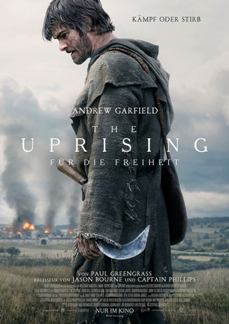 In 1381 most of England is still reeling from the merciless Black Plague, and its subsequent grief ravaging the land. The fourteen-year-old Boy-King Richard (Woody Norman) prays and prays, as his regency council, influenced by Archbishop Sudbury (Stephen Dillane) and Treasurer Hales (Tom Hollander), make tyrannical decisions in his name, in his absence. Joan of Kent (Katherine Waterston) worries for her young son; Richard does not seek her advice. To refill the coffers depleted from the Hundred Years’ Wars, the council unwisely decide to pick the pockets of the poor.
In May, the Tax Collector’s (Sam Chapman) irreverent attitude whilst gathering the King’s new poll tax in Essex ignites the Peasants’ Revolt that erupts in June with Chief Justice Belknapp’s (Stanley Townsend) arrival. United by their belief in the right of survival and for justice, the quiet Ploughman (Andrew Garfield), the radical Priest, John Ball (Jamie Bell), and the protagonist Warrior, Wat Tyler (Cosmo Jarvis) join forces as the peasant-citizenry resistance grows across the countryside. En masse, they march to London from Canterbury to meet with their King, believing a miracle is on the horizon. Ball preaches to the revolutionaries, Tyler leads them; he rode in battle with Richard’s father, Edward, the Black Prince. The rebellion becomes brutal in London; negotiations between the forces are called. Scribe (Sky Yang) pushes the scribers to fulfill their duty, as London’s Mayor Walworth (Jonny Lee Miller) finagles. For years to come, King Richard II is reminded nightly of the power of “just words.”
Writer-director Paul Greengrass’s great thriller has a clear historically sound through-line, excluding minor tweaks to embellish the narrative, e.g., Thomasin McKenzie portrays Alyce, symbolizing women’s importance during the uprising, and Ploughman, representing the ordinary people. The cast excel in portraying their entangled characters’ personalities. Production values replicate that time-period: Cinematographer Pål Ulvik Rokseth’s range and scope shooting on location in the northern Bavaria, Germany region offered unique visual imagery with its preserved medieval towns and landscape; production designers Renátó Cseh and Nikolaj Danielsen continually adapted Nuremberg’s 13th century St. Sebaldus Church, a main filming location; costumers Tóth András Dániel and Godena-Juhász Attila’s small Hungarian workshop traveled with the production company working non-stop; William Goldenberg astutely edits; and Volker Bertelmann’s score was recorded in Paris, Vienna, and London. The disillusionment this venture bred could be described as Richard II’s “let them eat cake” moment incurring repercussions that lasted decades. 127 minutes (Marinell H.)