

Austria | Germany | France | Sweden 2026
Opening September 17, 2026
Directed by: Marie Kreutzer
Writing credits: Marie Kreutzer
Principal actors: Léa Seydoux, Jella Haase, Laurence Rupp, Catherine Deneuve, Sylvester Groth
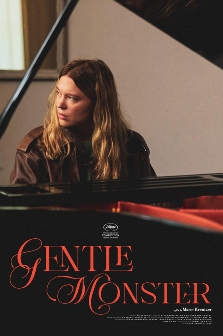 Marie Kreutzer’s exquisitely crafted Gentle Monster’s scope, lowkey transcendent performances, and enigmatic-seeming premise, until details in the script supply verisimilitude which takes one’s breath away. Writer-director Kreutzer, during a press conference at Cannes, explained she chose this difficult topic after reading a newspaper article. “I do not only know victims—I must know perpetrators as well.… I just felt helpless after reading it and I felt that the only thing that I could do, as a filmmaker, as a storyteller, is make a film about it.” The topic deserves more attention.
Kreutzer’s pacing is important as she introduces the characters: the accomplished, successful musician Lucy Weiss (Léa Seydoux), her husband Philip Weiss (Laurence Rupp) whose mental acuity concerns her, and their son Johnny (Malo Blanchet) a talkative, rumbunctious lovable five-year-old. Elsa Kühn (Jella Haase), the leading detective with CID Munich, is concerned about her father Hermann Kühn’s (Sylvester Groth) declining health, and live-in caregiver Natalia’s (Patrycja Ziółkowska) dilemma.
The Weiss family trade the city stress for the countryside quiet. Their old, refurbished farmhouse provides Lucy and her baby grand piano ample room for composing, Philip space for his technical filmmaking gadgetry plus plenty of filmable subject matter, particularly the long spacious tree-studded back garden, and Johnny’s spirited antics on the trampoline. Frau Kühn’s arrival with her team and perfunctory search warrant shatters their tranquility: Philip instructs Lucy to call Lukas (Nils Strunk) their friend/lawyer; learning the extent of Philip’s trouble is a gut punch to Lucy. Her mother Eloise (Catherine Deneuve) provides support and space for two.
Off duty Elsa’s private life is overshadowed by apprehension for Hermann’s dementia; he confuses Elsa with being her mother. Natalia warns his deterioration carries over to unsuitable, frisky actions toward her. Elsa’s seen it all in her line of work; a good listener, she speaks with uncompromising candor and stays on point. Perpetrators’ excuses run the gauntlet; wives too often choose deniability. as Elsa and Lucy’s predicaments continue, evolve, their assessment of each other changes.
Gentle Monster premiered in competition at the 79th Cannes Film Festival. The cast performances infuse the range of analogous characteristics typifying/gender specific reactions of individuals involved. Johnny speaks predominantly French, while the adults fluently slide from German to English to French. A key attribute of Gentle Monster is its women: its lead characters share similar problems, and its director (Kreutzer), cinematographer (Judith Kaufmann), and editor (Ulrike Kofler) sterling production values emphasize its balance. Audiences see close-hand the raw emotional effect, its magnitude, intensity. Foundations shattered, individuals’ unsettling doubts, anxieties and (trying to) cope. Certainties and trust undermined, forcing painful truths. 115 minutes (Marinell H.)