

½
USA | Hungary 2025
Opening May 7, 2026
Directed by: James Vanderbilt
Writing credits: James Vanderbilt, Jack El-Hai
Principal actors: Rami Malek, Russell Crowe, Michael Shannon, Richard E. Grant
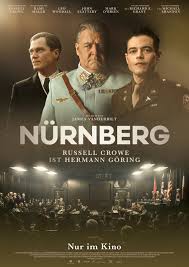 World War II is finally over, and on May 8, 1945, the US 36th Infantry Division is on patrol near Radstadt, Austria. An armored 1937 blue Mercedes-Benz 540K Roadster (the “Blue Goose”) rolls up and out steps a larger than life, amiable, overly confident German officer, offering to surrender to the Americans. His wife and daughter are sitting comfortably in the back seat. Arrogant and obviously used to being the man in charge he unabashedly commands the American soldiers, as they arrest him, to take his luggage out of the trunk. The officer is Reichsmarschall Hermann Göring (Russell Crowe), second in command to Adolf Hitler. Göring has cunningly surrendered to the Americans rather than to the Russians, confident that they would treat him well. What he has not reckoned with is the newly established International Military Tribunal (IMT), which would later become known as the very first of the historic Nuremburg trials. The Allied Forces had joined together establishing tribunals to hold individuals rather than nations responsible for war crimes against humanity—the first time in world history. Even if Göring had suspected he would eventually have to stand trial before a panel of judges, it could be argued he doesn’t seem especially ruffled.
There have been more than fifteen films and mini-series depicting the Nuremberg trials. The first was a documentary, The Nuremberg Trials, produced by Roman Karmen and released in the United States in May 1947. Judgment at Nuremberg (1961), directed by Stanley Kramer, starring among others Spencer Tracy and Burt Lancaster, is an Oscar-winning classic. The TV mini-series Nuremberg (2000) directed by Yves Simoneau, with Alec Baldwin and Christopher Plummer, is highly acclaimed and has gained a wide audience. So why another film about the Nuremburg trials?
Director James Vanderbilt has yet another vision. He bases his film on the book The Nazi and the Psychiatrist, by Jack El-Hai. El-Hai explores the relationship between Reichsmarschall Hermann Göring and Major Douglas Kelley (Rami Malek), a psychiatrist and an Army Military Intelligence Corps officer. Kelley has been assigned to determine if the twenty-two high ranking Nazis prisoners being tried at the tribunal in Nuremberg had the mental competence to stand trial. Kelley is to keep an especially close eye on their biggest prize, Göring. He is also asked to assess the likelihood of Göring and his fellow prisoners of following in the Führer’s footsteps and committing suicide, something the Allies wanted to avoid at all costs.
Kelley and Göring form a close bond that at times resembles friendship. Göring pours on the charm while smarmy Kelley entertains him with magic tricks and clever banter. They have long, both intimate and intellectual conversations. Kelley even smuggles letters between Göring and his wife Emmy and is adored by Edda, their young daughter. Only occasionally does Göring take off his manipulative mask of effusive geniality and pounce. Kelley himself is on a secondary mission. Göring and the others are his laboratory rats. He is trying to determine if the Nazis were intrinsically evil, or merely opportunists who grabbed power and exploited others. At the end of World War II everyone wanted to believe that the Nazis shared an innate derangement syndrome that explained their atrocious acts. In the years to follow Kelley promoted the unpopular, darker theory that the Nazis were not innately evil, only opportunists; that meant in the future citizens of other nations could repeat such monstrous acts.
The Nuremberg Palace of Justice is the setting for the film. The trial scenes highlight the brilliance and mental agility of Göring when being cross-examined by the idealistic, soft spoken, ineffective American Justice Robert H. Jackson (Michael Shannon). Göring insists that the “work camps” were only meant as temporary housing until all the Jews could emigrate to other countries. Sitting in the audience Kelley concludes that his prediction was correct, Justice Jackson doesn’t have a chance against the wily Göring.
But then the British prosecuting counsel Sir David Maxwell-Fyfe (Richard E. Grant) steps in. He has documents linking Göring to the persecution of the Jews. More than this he has a secret weapon: shockingly brutal film footage taken at the concentration camps, depicting massive piles of rotting corpses and emaciated live victims filmed by the Allied soldiers. Up until this time only the liberating soldiers had witnessed such heinous scenes. Göring glances down, squirms a little. Then Maxwell-Fyfe twists the knife and asks Göring—namely, having just watched the concentration-camp footage, would you still swear fealty to Hitler? Göring, the loyal soldier, concedes, yes, he would. That seals his fate.
Crowe is brilliant as Göring, his German accent is acceptable (for an Aussie). The way he switches from the likeable, genial prisoner to a menacing monster in a split second is remarkable. Rami Malek as Kelley sometimes made my skin crawl, but maybe that’s what psychiatrists are meant to do. Cinematographer Dariusz Wolski, with a single camera, brilliantly captures the claustrophobic intimacy of the tiny prison cell where the two, Göring and Kelley, spend their endless days. The courtroom scenes are reminiscent of historic film footage of the trials in the original documentaries. Director-writer James Vanderbilt uses no bells or whistles, no gimmicks. He made a solid, nostalgic, old-fashioned film, the kind that used to win Academy Award nominations. Somehow Nuremberg escaped the notice of the movie award-ceremonies this year. But perhaps that is the perfect reason to go and watch the film. (Pat F.)
ANOTHER OPINION BY MARINELL H.
½
The eponymous epic chronicles pivotal events occurring one day after Germany’s WWII surrender. Based on Jack El-Hai’s 2013 book, The Nazi and the Psychiatrist and personal accounts, it has elements of a thriller, legal and psychological drama, character studies, and biographical details. The cast is stellar: Fictional characters, e.g., Leo Woodall as Sergeant Howie Triest, translator, highlight important issues and/or springboard action forward at a pace defying its 148-minutes running time.
James Vanderbilt, writer-director, crafted a cautionary tale. Beginning May 8, 1945, when Adolf Hitler’s plenipotentiary, Reichsmarshall Hermann Göring (Russell Crowe), surrenders it sets in motion associate U.S. Justice Robert Jackson’s (Michael Shannon) involvement, and raises the issue of consequences, i.e., implementing peacetime punishment for wartime crimes by means of international tribunals. Nürnberg, Germany, in northern Bavaria is renowned for the Third Reich’s yearly mass party rallies, and the Nuremberg Trials. Twenty-four Nazi war criminals were tried by France, the Soviet Union, the United Kingdom, and the United States during the initial International Military Tribunal (IMT), November 20, 1945, to October 1, 1946. This distinct juncture from precedence was historical; from the outset, the only thing certain was uncertainties regarding the process and the outcome.
Launching itself at a startling pace, the main protagonists are terrific: Russell Crowe’s hypnotic performance as Göring is stunning, multifaceted, and cunning right down to his German accented English; Rami Malek’s transformative portrayal manifests U.S. Army psychiatrist Douglas Kelley’s counterintuitive gullibleness, while Michael Shannon’s studied, penetrating portrayal displays Jackson’s deep moral fortitude. As chief psychiatrist at Nuremberg Prison, Kelley must determine defendants’ mental competency before the trials. Later he defended the tilted relationship he had with Göring by referencing his interest in and study of “living symbols of evil.”
Polish cinematographer Dariusz Wolski’s fluidity ranges from wide angle landscapes to intimate overtones in courtroom/prison cell performances. New Zealand editor Tom Eagles’s control, finesse ensure audiences keep up; archival footage from Nazi-run concentration/labor camps the Allied Forces recorded on film was powerful evidence at Nürnberg. Brian Tyler’s complex, absorbing score, Bartholomew Cariss, costume design and Eve Stewart’s production design are unshakeable.
The Nuremberg Trials continued until 1949 with 199 high-ranking defendants prosecuted. Audiences experience Nürnberg’s chilling reality—the buildup is harrowing, commitments are unfathomable, history tragic. Disbelief belied truth, until the incomprehensible was fact, and the inconceivable became public knowledge. History is no friend to fools nor folly.