

France | Germany | Netherlands |Latvia |Romania |Lithuania |Ukraine 2025
Opening December 18, 2025
Directed by: Sergey Loznitsa
Writing credits: Georgy Demidov, Sergey Loznitsa
Principal actors: Aleksandr Filippenko, Alexander Kuznetsov, Anatoliy Beliy
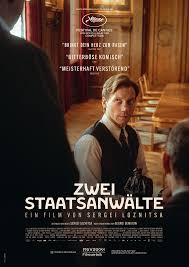 It’s haunting. It’s chilling. And yet somehow you can’t look away. The film begins with the camera focused on a massive iron prison gate. As it opens the audience is invited to go inside a bleak prison to observe the soon-to-be corpses, political prisoners of Stalin’s Great Purge, still shuffling about. One prisoner is given the secret task of burning all the desperate letters written to Comrade Stalin by the inmates, all protesting their innocence and begging him for mercy. One note written on a scrap of cardboard, in blood, signed by Stepniak (Aleksandr Filippenko), is smuggled out of the prison and miraculously finds its way to the young, idealistic, impeccably dressed government prosecutor, Kornev (Alexander Kuznetsov). Every story needs a hero, but from the desolate opening, the prison scene, a precursor of the Holocaust death camps, the audience already has a premonition that idealism in Stalin’s Soviet Union is meant to be quashed.
Handsome, clean cut, soft-spoken Kornev, straight out of law school, has been appointed state prosecutor in his hometown Bryansk. He traces the desperate note to the local prison, and after a long wait meets with prisoner Stepniak. Kornev is visibly shaken when he is led to Stepniak, a bare skeleton of a man yet with enough flesh to show him his scars from prison torture. Kornev recognizes him as the highly esteemed intellectual who had lectured at his university law school. Stepniak desperately pleads with Kornev to go to Moscow, to the Politburo, and plead for justice for himself and for the other prisoners, mostly Old Bolshevists and Stalin loyalists. Stepniak, the loyal inmate, who has never betrayed his comrades, alleges that the secret police, the NKVD, are to blame for their imprisonment; once the high officials in Moscow hear the truth, they will all be released.
Kornev sets forth on a train to the capital. He is determined to meet with the Procurator General of the Soviet Union, Andrey Vyshinsky (Anatoliy Beliy). Kornev is convinced Vyshinsky will certainly be eager to investigate such a massive abuse of power once he has heard Stepniak’s story and has seen the desperate note written in blood.
The film is adapted from a 1969 book, of the same name, by physicist and Gulag survivor Georgy Demidov. The mood is somber and devastatingly slow. We watch Kornev interact with a number of characters, some Kafkaesque: the menacing prison warden, the crusty old soldier with the wooden leg (also played by Aleksandr Filippenko), and the dazed, terrified man on the stairs in the procurator general’s building who keeps whispering to Kornev, wanting to know where the exit is.
Kornev takes the train back to Bryansk to the prison following the procurator general’s instructions to find more evidence. Kornev rides in a compartment with two businessmen (Valentin Novopolskij, Dmitrij Denisiuk) who he first suspects could be NKVD agents; but after some drinks and an impromptu musical performance he becomes trusting, relaxed, and more confident than ever he’ll find justice for Stepniak.
For the audience there are no surprises, no suspense—just waiting and watching, in slow motion, a lamb being led to the slaughter. The closing scene is reminiscent of the first, the camera focuses on the massive iron prison gate as Kornev once again enters. This time he has shed his innocence, idealism, and most frightening of all, his freedom. (Pat F.)